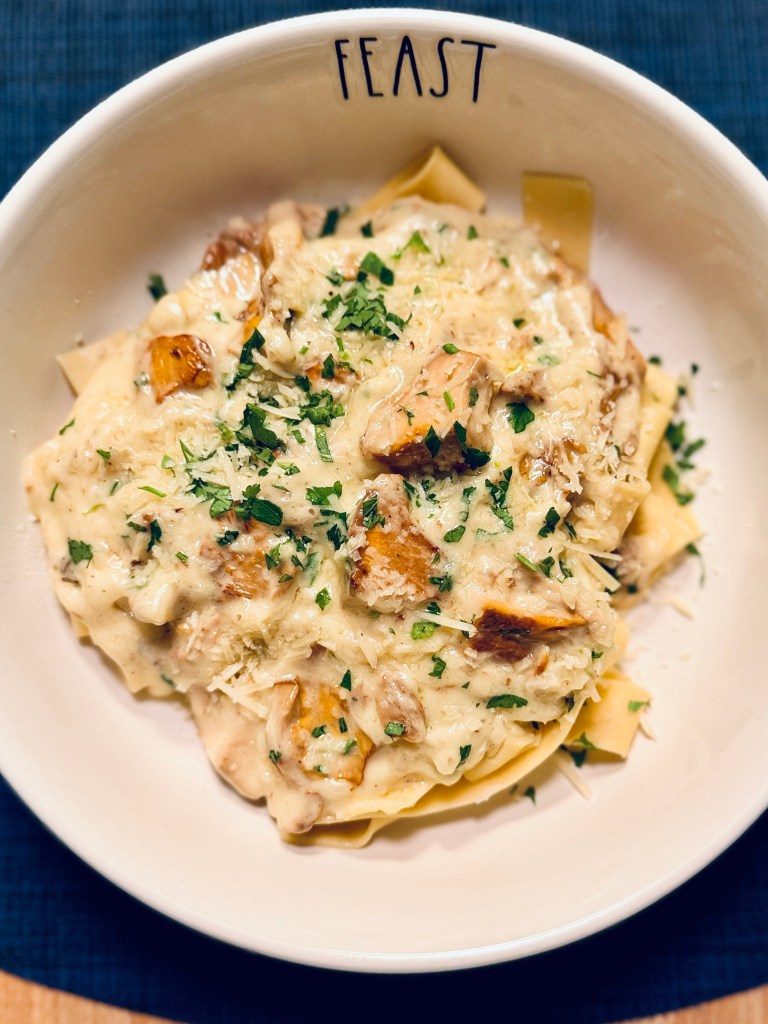
As fridge divers and pantry raiders, we never say “no” to leftovers and castoffs.
Our friend forages mushrooms in the Carmel woodlands for local restaurants . In early January, when he offered up some of the smaller and less “complete” chanterelles, our answer was “Yes, please!” And we came away with a beautiful haul.
My big push was to dry sauté the chanterelles first (something I do with other mushrooms). I think it gives a huge blast of flavor. And it didn’t disappoint here.
This made 2 large servings.
Ingredients
- 3/4 lb chanterelles, cleaned
- 1 teaspoon salt
- 1 tablespoon olive oil
- 1 diced shallot
- 4–5 tablespoons salted butter
- 1 tablespoon minced garlic
- 1 1/2 tablespoons fresh thyme (reserve some for finishing)
- 1 1/2 tablespoons chopped parsley (reserve some for garnish)
- 1 teaspoon (or more) of freshly ground black pepper
- pinch of nutmeg (optional)
- 1/2 cup dry vermouth or white wine
- 2/3 cup heavy cream
- 4-5 ounces pappardelle (I like Trader Joe’s butter pappardelle)
- Reserved pasta cooking water (about 1/2 cup)
- 1 teaspoon cornstarch (optional, for slurry)
- Shredded parmesan cheese, for garnish
Prepare the chanterelles
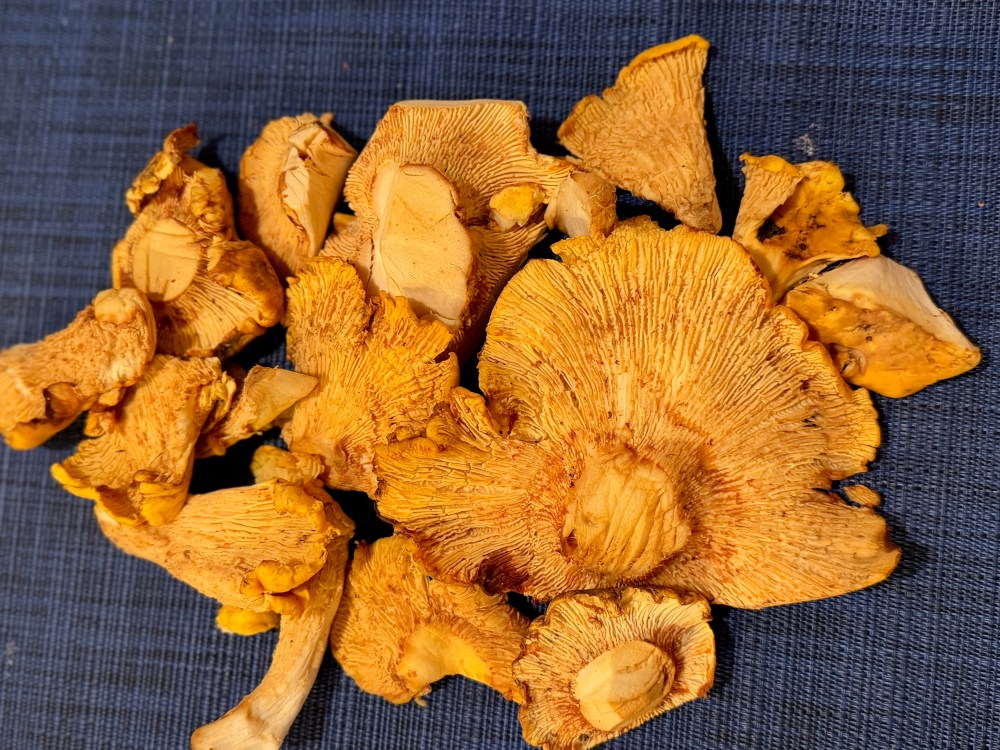
Clean foraged chanterelles carefully.
Soil often lodges grit deep in their false gills, so chanterelles nearly always need washing. Before you get out your soft-bristle paintbrush, small harvests can be gently rinsed under low running water, while larger harvests are best cleaned by soaking and swishing to release trapped sand. Once clean, the mushrooms should be thoroughly dried by blotting with a paper towel or carefully using a salad spinner, then air-drying to protect their delicate edges. After drying, we stored the chanterelles in a brown paper bag in the refrigerator, which allows them to breathe while retaining just enough moisture to keep them fresh for up to a week.
Cut/Tear chanterelles.
Tear or cut the chanterelles into roughly equal-sized pieces so they cook evenly. Smaller chanterelles can be left whole or halved, while larger ones should be cut into quarters. Remember that chanterelles shrink as they cook, so aim for pieces that will stay tender and flavorful without becoming too small.
Dry sauté the chanterelles.
Place a large skillet over medium-high heat. Once hot, add the chanterelles in a single, even layer. Sprinkle with a pinch of salt. Adding salt early helps draw out moisture and enhance their flavor. Stir the chanterelles occasionally. They will release their liquid; continue cooking for 5–10 minutes until the liquid evaporates. Once dry, the chanterelles should be lightly golden and dry but not crispy. Transfer the chanterelles to a plate and set aside. If you plan to move on to the sauce, there is no need to clean the pan.
Start the Pasta
I prefer not to precook my pasta and let it sit too long. Instead, I start the water when I start my sauce, then add the pasta while I cook. But when you’re ready, bring a pot of salted water to a boil and add your pasta. To avoid overcooked pasta, I suggest cooking the pappardelle for about 6-7 minutes, just under al dente, since it will cook in the sauce later. Reserve a cup of the pasta cooking water before draining.
Begin the sauce
Sauté the shallots.
Using the pan from the earlier sauté, heat about 1 tablespoon of olive oil over medium heat until it shimmers. Add the shallot and sauté until translucent.
Return the chanterelles and add butter.
Add 4–5 tablespoons of salted butter to the pan with the shallots, stirring until the butter has fully melted. Add the cooked chanterelles and gently toss until evenly coated.
Reduce heat and season.
Add 1 Tablespoon each of the thyme and parsley, a generous amount of freshly ground black pepper, and a pinch of ground nutmeg if desired. Then add about 1 tablespoon of minced garlic and cook for 1-2 minutes, stirring, until fragrant. The key is to cook the garlic without burning it.
Deglaze the pan.
Add about ½ cup dry vermouth to deglaze the pan, scraping up the browned bits, then gently simmer over lower heat for 1–2 minutes to reduce slightly.
Add cream.
Pour in the heavy cream, stirring to combine with the chanterelles and aromatics, then gently simmer for 2–3 minutes until the sauce is warmed and lightly thickened.
Adjust the sauce consistency and finish simmering.
If the cream sauce isn’t thickening to your liking, mix 1/2-1 teaspoon of cornstarch with about 1/4 cup of the reserved pasta cooking water to make a smooth slurry. Gradually stir the slurry into the sauce over low heat, adding only as much as needed to reach the desired consistency. Let the sauce simmer gently for 3–5 minutes, stirring occasionally, until it is smooth, slightly thickened, and the flavors have melded. The sauce will thicken as it cools, so don’t be over-zealous!
Toss the pappardelle in the sauce.
Add the drained, cooked pappardelle directly into the pan with the chanterelle cream sauce. Toss gently over low to medium heat until the pasta is fully coated with the sauce. Add the remaining fresh thyme at this stage for a final aromatic lift. If the sauce seems a little thick, add a splash of the reserved pasta water to loosen it.
Prepare for the table.
Garnish and Serve
Taste and adjust seasoning with additional salt and freshly ground black pepper if needed. Serve immediately, garnished with chopped fresh parsley and a generous sprinkle of Parmesan cheese.
Pairing Suggestion
Because the chanterelles have a nice nutty flavor in this recipe, I recommend a light pinot noir.
 Living Life Forté